This year marks the 70th Anniversary of General Motors operating in Arlington. Since the first car rolled off the line at the Arlington plant in January 1954, more than 13 million vehicles have followed.

Early 2020s aerial view of GM Arlington Plant, with Arlington’s Entertainment District in background
Photo Credit: City of Arlington YouTube channel
A new identity
In 1950, Arlington was a small town of about 7,500 people, with much of the surrounding area still farmland. The town was little more than a blip on the map between Dallas and Fort Worth.

Aerial view of Arlington and surrounding area, showing land purchased by GM, early 1950s;
much of the area is undeveloped at this time
Photo Credit: UTA Libraries – Digital Gallery
Tom Vandergriff, and his father, W.T. Hooker Vandergriff, were instrumental in helping to bring the GM Plant to Arlington. At this time, Tom was President of the Arlington Chamber of Commerce, while W.T. owned a thriving Chevrolet dealership downtown. From their connections, they learned that GM wanted to develop a site in the Midwest, potentially in the Dallas-Fort Worth area. Both thought that it could be an opportunity for Arlington. The town had vacant land and was situated between two major cities. Besides, Vandergriff had a dealership and showroom floor where he could sell some of those shiny, new cars.
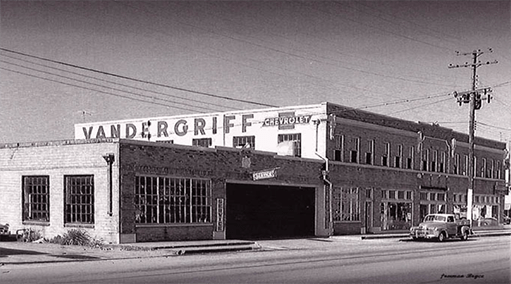
Vandergriff Chevrolet
Photo Credit: Vandergriff Building.com
In March 1951, Tom Vandergriff was elected Arlington’s Mayor. He was soon in Detroit, talking with General Motors about bringing an assembly plant to Arlington. General Motors purchased 255 acres of land in East Arlington for its new site in August. Vandergriff had the insight, vision, and drive to make the deal happen. A little bit of luck didn’t hurt, either.

Early 1950s: Mayor Tom Vandergriff shows the future site of the General Motors assembly plant in Arlington.
Photo Credit: UT Arlington Special Collections
It was an extraordinary achievement for Arlington to get the GM plant, one that would forever change the trajectory of our small town. Vandergriff worked with leaders in Dallas and Fort Worth collaboratively, focusing on the region’s growth rather than the wins or losses of an individual city. And he made sure to have those leaders at the groundbreaking, shovels in hand, standing side-by-side, working together as a team. An initial competition among the cities became a collaborative and congratulatory event. That’s undoubtedly a rarity in businesses and municipalities.

May 27, 1952: From left, Ben Critz, Tom Vandergriff, Amon Carter Sr., and John F. Gordon were the first to turn dirt at the new General Motors plant in Arlington during the groundbreaking ceremony.
Photo Credit: Fort Worth Star-Telegram archive/UT Arlington Special Collections
Early years
When the plant opened in January 1954, a Pontiac Chieftain was the first car to roll off the assembly line. Early production focused on Buick, Oldsmobile, Pontiac, and even military aircraft, as needed. The plant primarily shifted to Chevrolet cars in 1963. From the 1960s through the 1990s, the plant produced a mixture of iconic vehicles, including the Chevrolet Bel Air, El Camino, Impala, Malibu, Monte Carlo, and others from the General Motors lineup.

January 6, 1954: First car produced at the General Motors plant in Arlington, TX: left to right, J.L. Conlon of General Motors; Tom Vandergriff, Mayor of Arlington; E.C. Klotzburger, Arlington GM plant manager.
Photo Credit: UTA Libraries – Digital Gallery
The arrival of the General Motors Plant—remarkable in and of itself—led to more jobs, a population surge, and staggering growth. It resulted in a domino effect for Arlington. Housing divisions sprung up; developers and other real estate ventures flourished. By necessity, Arlington grew after the plant’s arrival. Lake Arlington, the Dallas-Fort Worth Turnpike, Arlington Memorial Hospital, and other amenities soon arrived to meet the needs of a growing town.
Arlington Population by decade (1950-2000) and most recent population sign:
- 1950—7,692
- 1960—44,775
- 1970—90,643
- 1980—160,113
- 1990—261,721
- 2000—332,969
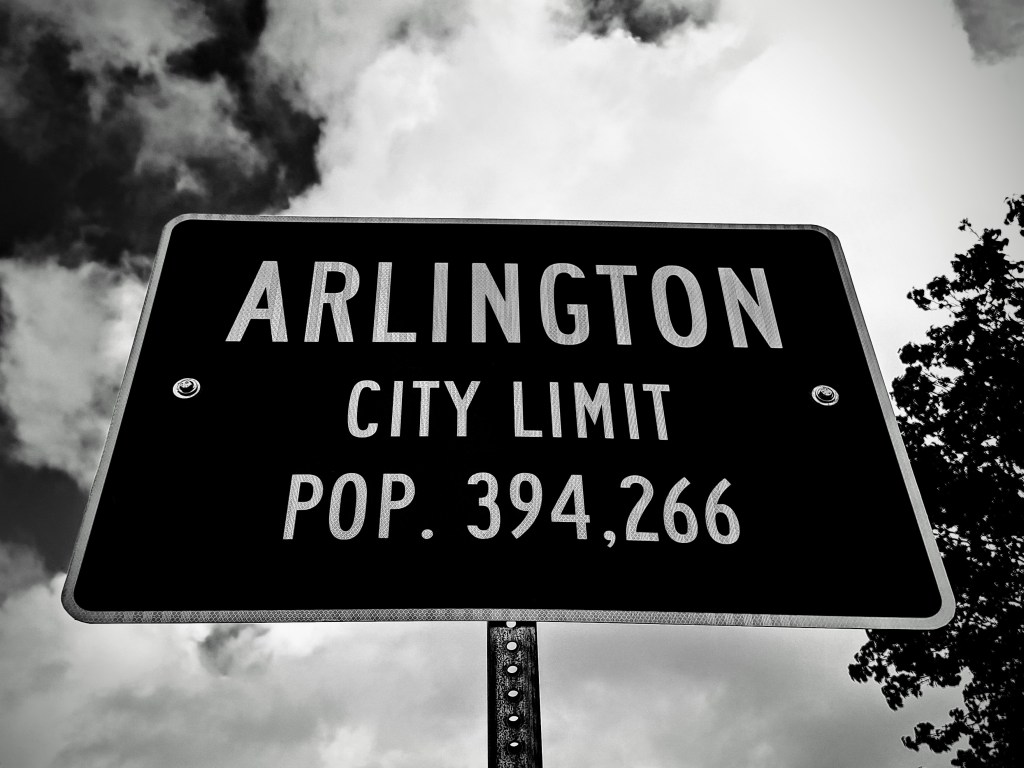
Arlington became a “boomburb,” a fast-growing suburb of post-World War II. People began to leave major cities and seek suburbs; many found a new home in Arlington and other towns like it. By 1960, Arlington’s population had reached nearly 45,000 people, doubling to 90,000 by 1970. The growth continues today, with Arlington nearly at 400,000 people and the third largest city in the DFW Metroplex. Much of that can be attributed to the GM plant. GM brought more jobs to Arlington than were in the town before they arrived. Years later, Tom Vandergriff said: “For us to get a giant industry to come our way, it was a turning point in our history.”

April 3, 1986: Employees at the General Motors plant in Arlington look over a line of Oldsmobile Cutlass automobiles.
Photo Credit: Fort Worth Star-Telegram archive/UT Arlington Special Collections
1990s recession
Conversely, another turning point in our history almost happened in the early 1990s. Automobile plants are challenging for cities to get and even tougher for them to keep. Arlington nearly lost GM, which would have been a devasting blow to our economy. A recession took hold, with GM seeking ways to cut costs. GM announced in late 1991 that the plant in Arlington, or the one in Willow Run, Michigan, would close. Willow Run began operations in 1959 and was a sister site to Arlington; both had been vital parts of their communities for over 30 years.
Officials in both towns worked feverishly to keep their GM plants open. Arlington Mayor Richard Greene called an emergency city council meeting and formed a coalition. He even enlisted the help of former Arlington Mayor Tom Vandergriff, who had stepped down 15 years earlier. Texas Governor Ann Richards also got involved and offered GM incentives to stay in Texas. A community bumper sticker campaign, followed by billboards, touted—Keep GM, The Heartbeat of Arlington—as a play on Chevrolet’s “The Heartbeat of America” slogan. Arlington showed cooperation and commitment. It worked.

The Heartbeat of America campaign
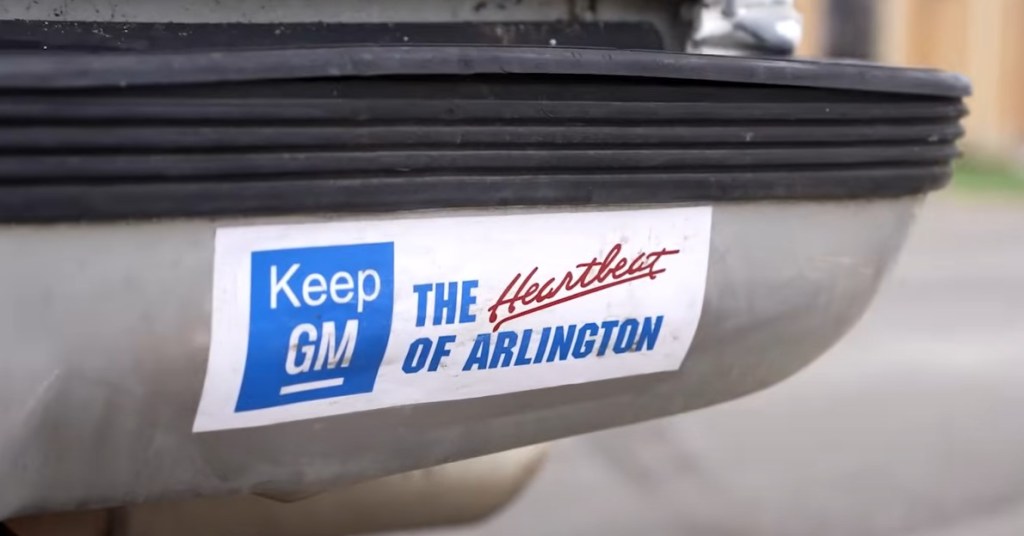
Keep GM, The Heartbeat of Arlington bumper sticker
Photo Credit: City of Arlington YouTube channel
GM ultimately decided to consolidate the operations from Willow Run into Arlington’s plant. The move kept at least 3,700 jobs in Arlington and would add 1,000 more in the next few years; the plant would also add a third shift to the production line. However, employees in Texas muted their celebrations, showing compassion to the ones in Michigan who lost their jobs. Many from Michigan transferred to the Arlington plant, though. It was a pivotal time in Arlington’s history, as the pendulum could have easily swung the other way with significant implications.
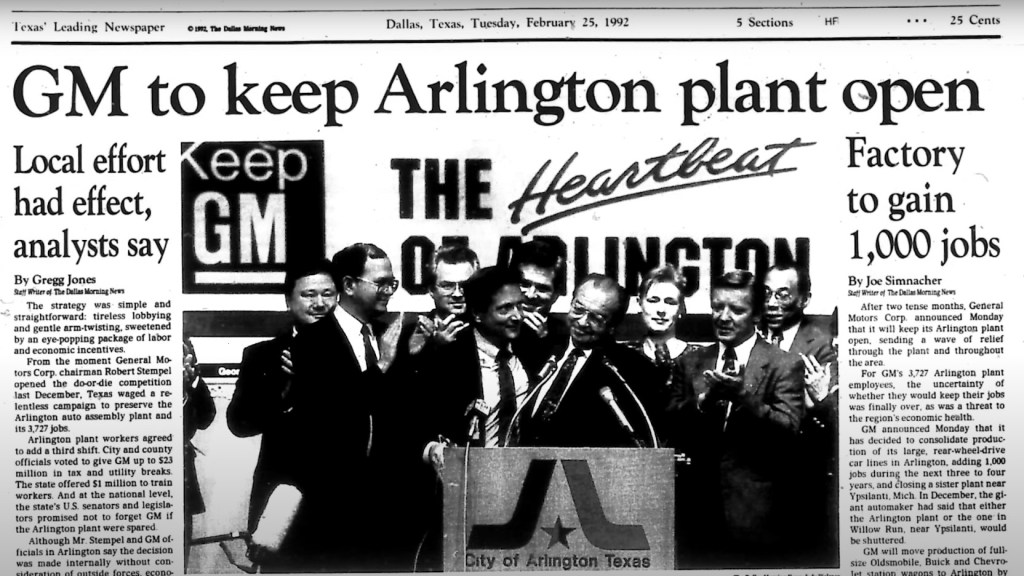
The Dallas Morning News — February 25, 1992
Photo Credit: City of Arlington YouTube channel
Uncertainty lingered, though, as the Arlington plant was still producing a car (the Chevrolet Caprice) that wasn’t selling enough to meet the supply. The operation needed to reconfigure and build a different vehicle. It took a few years, but they began producing Chevy pickup trucks in 1997, with Texas-sized demand helping fuel the supply. Texans love their trucks and SUVs. It was a new beginning for the plant. Robotics, automation, and state-of-the-art manufacturing started to become more common by this time, making operations more efficient.

First Truck assembled at GM Arlington — April 24, 1997
Photo Credit: City of Arlington YouTube channel
City leadership was instrumental in keeping the plant here, but indeed, the workers kept (and keep) it running.
Production
For over 20 years, the plant has focused on assembling large SUVs, with its current lineup including the Chevrolet Tahoe, Chevrolet Suburban, GMC Yukon, GMC Yukon XL, Cadillac Escalade, and Cadillac Escalade-V. Of the full-sized SUVs on U.S. roads today, it’s estimated that 75% came from Arlington. Production runs six days a week, 24 hours a day. They can build a vehicle from start to finish in 24 hours, with one rolling off the assembly line nearly every minute. The plant does stamping, bodywork, painting, and general assembly. It is a large, high-volume manufacturing complex that is viable, efficient, productive, and profitable. The plant also provides opportunities to small businesses, suppliers, and others in the supply chain.
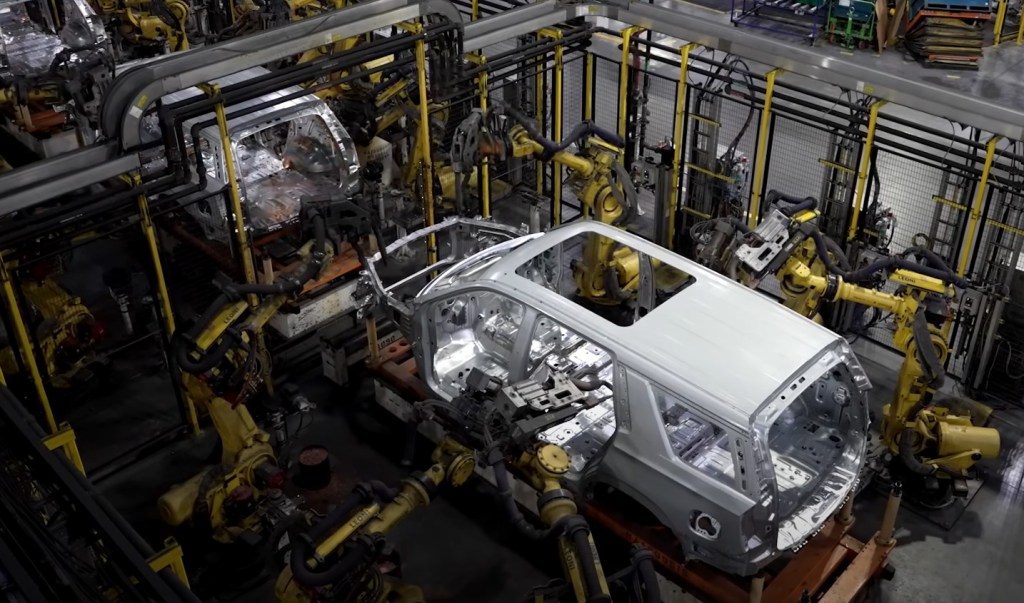
Robots hard at work in the GM Plant
Photo Credit: City of Arlington YouTube channel
Employees
With over 5,000 employees, the GM plant is one of Arlington’s largest employers and industrial taxpayers. The plant also occupies a sizable chunk of land, with a 5.75 million square feet footprint on 250 acres. GM Financial, a subsidiary of GM, employs another 3,000 employees a few miles from the assembly plant. The two greatly boost the local economy.
Employees take pride in their work and reap the economic opportunities it brings. GM offers competitive pay, comprehensive benefits, career development, and sustainable retirement options. It’s not uncommon for generations from the same family to work there, and most people who get a job with GM stay around for a while. Billy Bell, Team Leader at the Arlington plant, started working there in 1962. He still works there 62 years later. Says Bell: “General Motors has been good to me. Everything I’ve got, I owe to them.”
70th Anniversary
The year 2024 marked two notable milestones for the GM Arlington Assembly. They celebrated their 70th Anniversary and produced their 13 millionth vehicle—a 2024 Cadillac Escalade-V. It’s a luxurious model with an MSRP of about $150,000.

2024: GM celebrates 70th Anniversary and 13 million vehicles
Photo Credit: City of Arlington YouTube channel
City officials officially proclaimed July 26th as General Motors Day in Arlington. Stakeholders, community members, GM employees, and city officials attended the anniversary celebration. It was a momentous occasion.
The 70th Anniversary culminated with the City of Arlington releasing a new documentary on its YouTube channel. “The Heartbeat of Arlington,” released in November, looks at how the GM plant came to town, its lasting impact on the community, and its resilient spirit, which is the heartbeat of Arlington. It contains archival footage, news clips, photographs, interviews, and a behind-the-scenes look at operations to help tell the story.
The Heartbeat of Arlington documentary
Photo Credit: City of Arlington YouTube channel
Lasting impact
It is a significant achievement for a major industry to stay in a community for decades. It’s a mutually beneficial relationship; as the GM Plant grew, so did Arlington. The longevity is a testament to GM and the community working together to form a legacy. Over the last 10 years, GM has invested over $2 billion in the Arlington plant, an investment in our community and the future.
Getting the GM plant was a pivotal moment in Arlington’s history. Their arrival paved the way for the Great Southwest Industrial District, Six Flags Over Texas, the Texas Rangers, and likely even the Dallas Cowboys. Indeed, Arlington would be a much different city today without GM, and we’re fortunate that they have stayed here for 70 years as part of our community.
Production milestones
- 1 millionth vehicle: 1965 Pontiac Bonneville
- 2 millionth vehicle: 1971 Oldsmobile Cutlass
- 3 millionth vehicle: 1976 Oldsmobile Cutlass Supreme
- 4 millionth vehicle: 1981 Chevrolet Monte Carlo
- 5 millionth vehicle: 1985 Chevrolet Monte Carlo SS
- 6 millionth vehicle: 1993 Buick Roadmaster
- 7 millionth vehicle: 2002 Cadillac Escalade
- 8 millionth vehicle: 2006 Chevrolet Tahoe
- 9 millionth vehicle: 2011 Chevrolet Suburban
- 10 millionth vehicle: 2015 Chevrolet Suburban
- 11 millionth vehicle: 2018 Chevrolet Tahoe RST
- 12 millionth vehicle: 2021 Chevrolet Suburban
- 13 millionth vehicle: 2024 Cadillac Escalade-V


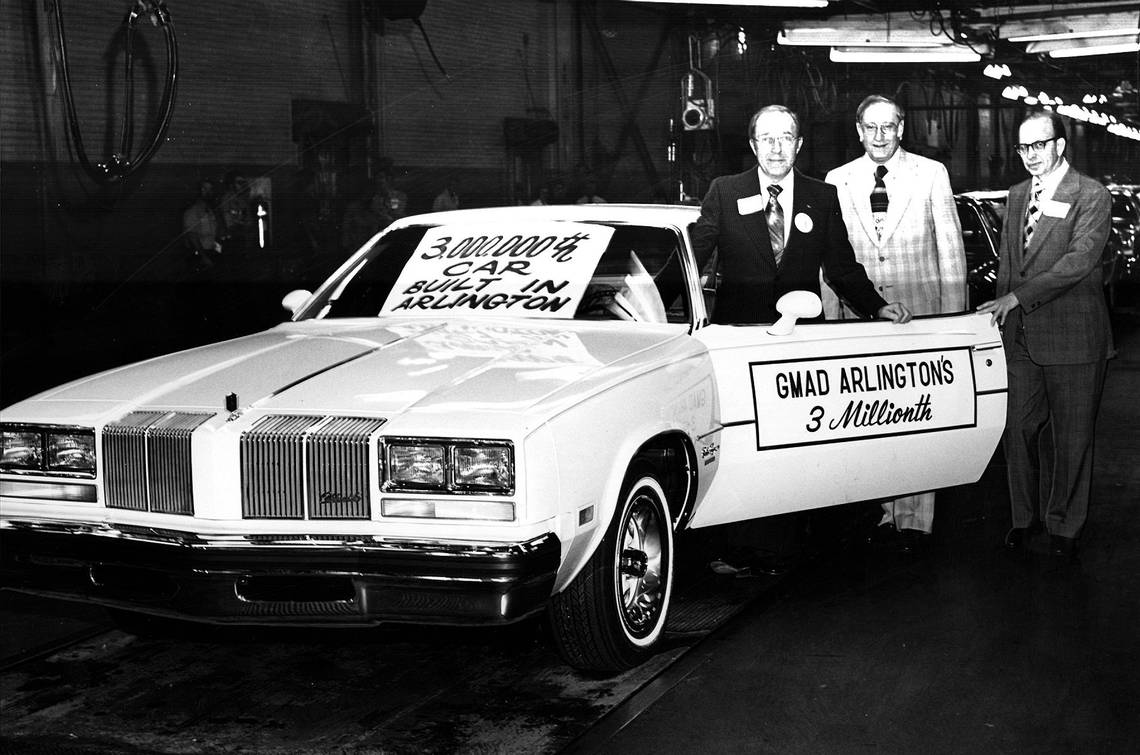


Production Milestones throughout the years
Photo Credits: Fort Worth Star-Telegram archive, UT Arlington Special Collections, City of Arlington, & General Motors
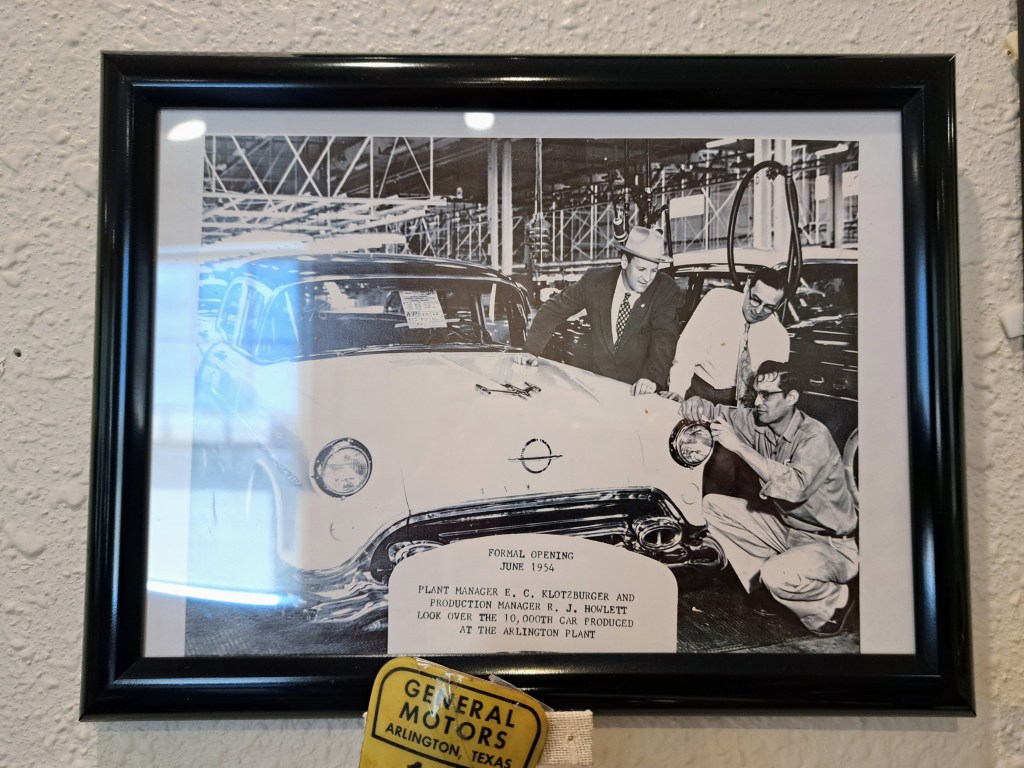
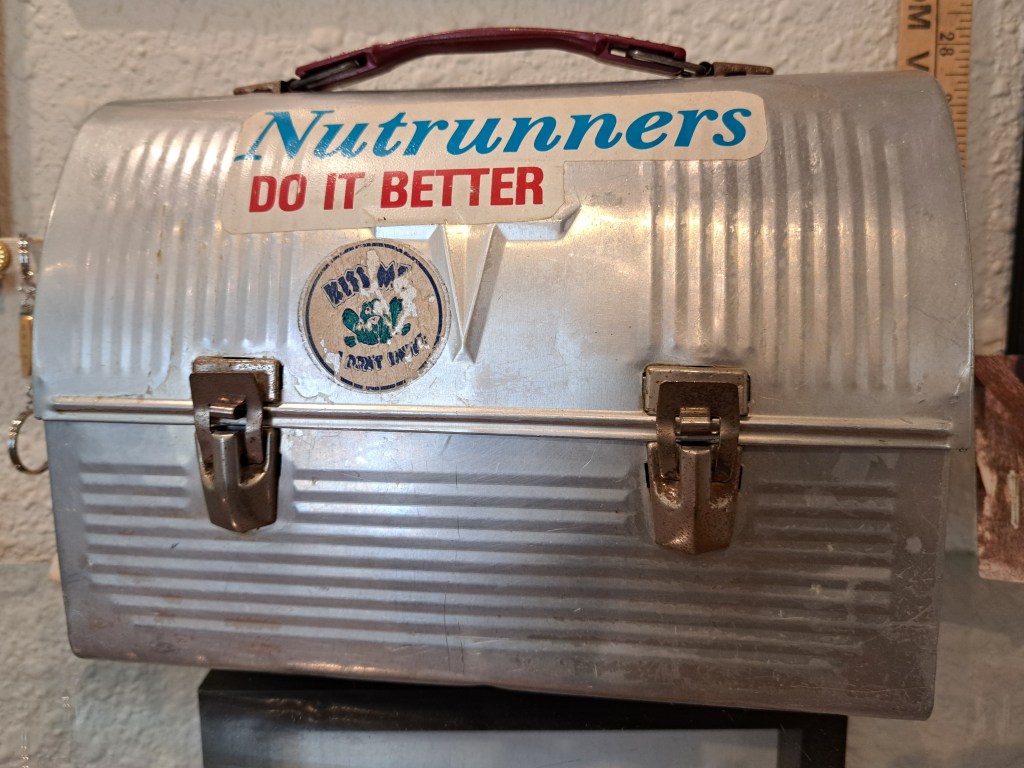
GM exhibit at Fielder Museum in Arlington
Fielder Museum is home to the Arlington Historical Society. We have a few GM items in our collection.




The Heartbeat of Arlington documentary
Blog post by Jason S. Sullivan, 12-05-24
 Jason S. Sullivan
Jason- someone needs to do a story on this guy!! Fascinating!! “Billy Bell, Team Leader at the Arlington plant, started working there in 1962. He still works there 62 years later”
LikeLike
I agree! He was featured some in the documentary, but an extended interview or oral history from him would be great!
LikeLike