November 2024 marks the 95th anniversary of the first race at Arlington Downs, a former horse racing track that is a fascinating part of Arlington’s history.
[Click or tap on smaller photos for larger one. Read on a laptop or tablet for optimal viewing.]

Publicity photo for Arlington Downs, 1933
Photo Credit: UTA Libraries and Fort Worth Star-Telegram
Arlington Downs
Thundering hooves. Cheering spectators. Thrilling races. Outstanding facilities. Welcome to Arlington Downs.
Did you know that from 1929 to 1937, Arlington had a horse racing track? Arlington Downs was a well-known and popular attraction that drew thousands of spectators. For a time, folks could legally gamble on the races, and it was common for considerable sums of money to change hands. The site helped put Arlington on the map for tourism. Although the racing track, grand stands, and buildings are long gone, the memory of Arlington Downs still remains.

Entrance to Arlington Downs, 1930s
Photo Credit: UTA Libraries and Jack White Photograph Collection

Aerial view of Arlington Downs; note the hundreds of cars on the left; approx. 1933
Photo Credit: UTA Libraries and Fort Worth Star-Telegram
W.T. Waggoner (1852–1934) was an oil tycoon and cattle baron behind Arlington Downs. A horse enthusiast himself, his influences (and finances) helped create one of the finest tracks in Texas. Waggoner built the track on his nearly 6,000 acres farm along Division Street, also known as U.S. 80 or the Bankhead Highway. This early east-west continental route brought people to and through Arlington and was a prime location for the track.
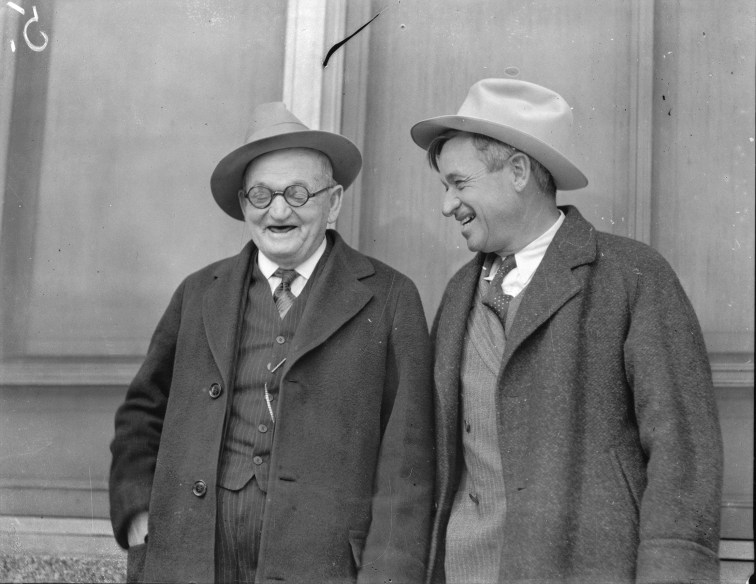
W.T. Waggoner (left) and Will Rogers (right)
at Arlington Downs racetrack, 10/19/1933
Photo Credit: UTA Libraries and Fort Worth Star-Telegram
Constructed at an estimated cost of $2-$3 million, equivalent to nearly $50 million today, the grandstands initially could hold 6,000 spectators. It had a 1.25-mile track, state-of-the-art facilities, attractive amenities, and landscaped grounds. It was a place to see and a place to be seen. Arlington Downs held its first race in November 1929. By 1930, Arlington’s population was fewer than 4,000—the whole town could fit inside the grandstands at the racetrack.

Panorama of Arlington Downs || Photo Credit: UTA Libraries
Waggoner lobbied the state capital to legalize gambling, knowing that he, the racetrack, and others could profit from it. His influence and effort were instrumental in convincing the Texas Legislature to legalize pari-mutuel betting in 1933. With pari-mutuel betting, bets are pooled, and the payout is calculated based on the odds; the racetrack also receives a share.
Gambling brought great excitement, interest, and crowds to the track. It also pumped more money into the facilities, which Waggoner remodeled to house an estimated 25,000 spectators. With legalized gambling, the track’s popularity, patronage, and profits soared. Waggoner wanted his track to rival the Kentucky Derby’s and spared little expense to make it happen.


Crowds at the track || Debutantes watching a race
Photo Credit: UTA Libraries and Fort Worth Star-Telegram

Horses breaking from the gate – Arlington Downs
Photo Credit: UTA Libraries and Fort Worth Star-Telegram
However, with Waggoner’s death in 1934, pari-mutuel betting lost one of its most influential supporters. Additionally, the lingering effects of the Great Depression and changing social opinions on gambling eventually prompted officials to repeal the measure after the 1937 racing season. Legal or not, spectators would often bet on the horses, but racing tracks themselves became less profitable. Despite its popularity, the heyday of Arlington Downs had peaked. The final horse race at Arlington Downs was in 1937.
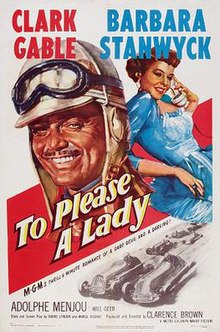
The story of Arlington Downs doesn’t end there, though. The facility was later sold to developers, who used the site for rodeos, auto racing, fairs, and other events. It was also used as a filming location for a few scenes of the 1950 movie “To Please a Lady,” starring Clark Gable as a notorious race car driver and Barbara Stanwyck as a writer, and later, his love interest.
Most buildings were torn down by the late 1950s, although one of the horse stables was believed to be still standing in the 1970s. Part of Waggoner’s farm and the site of Arlington Downs would later be home to the Great Southwest Industrial District and Six Flags Over Texas.
Photos of Arlington Downs memorabilia:

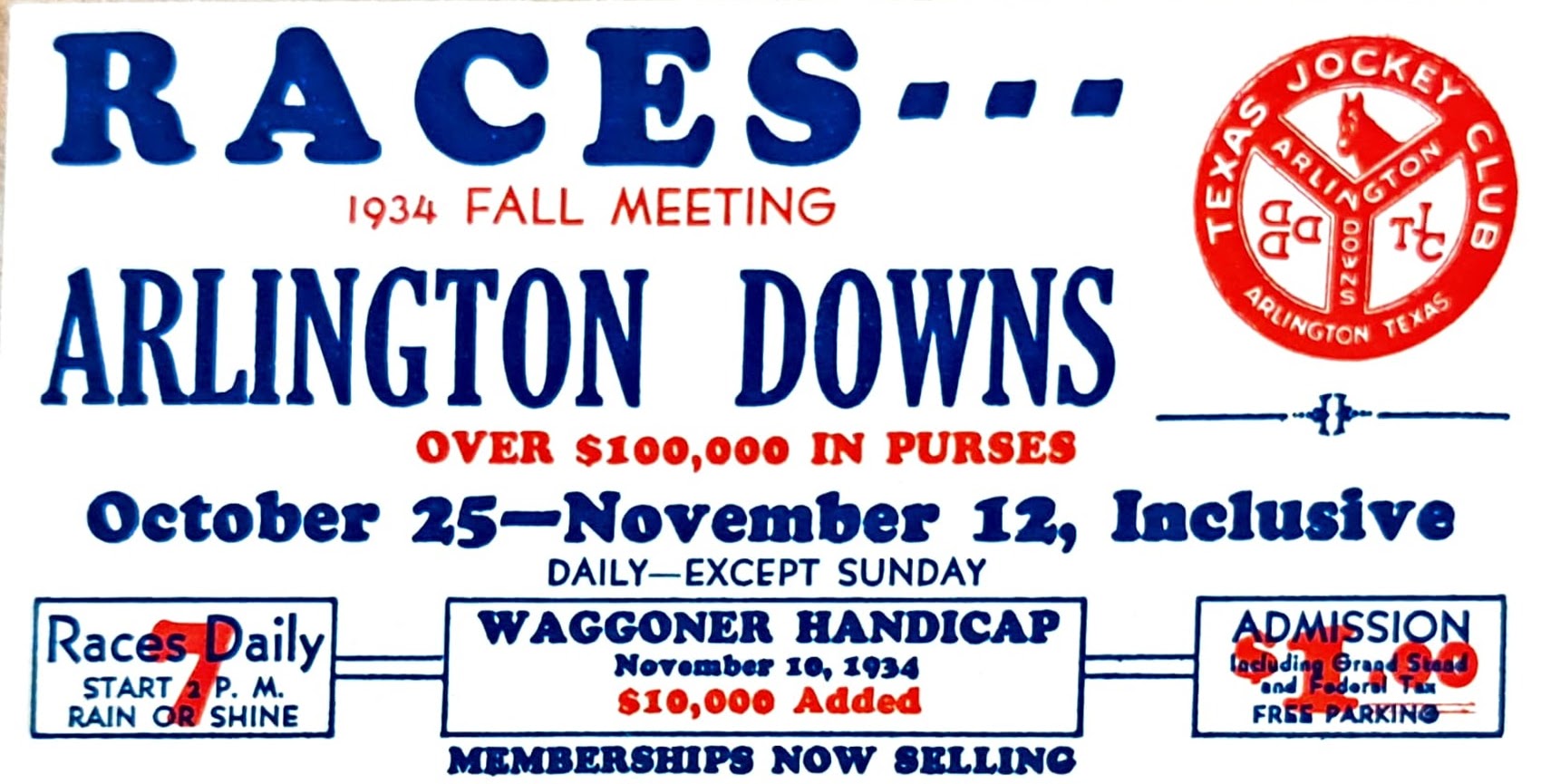

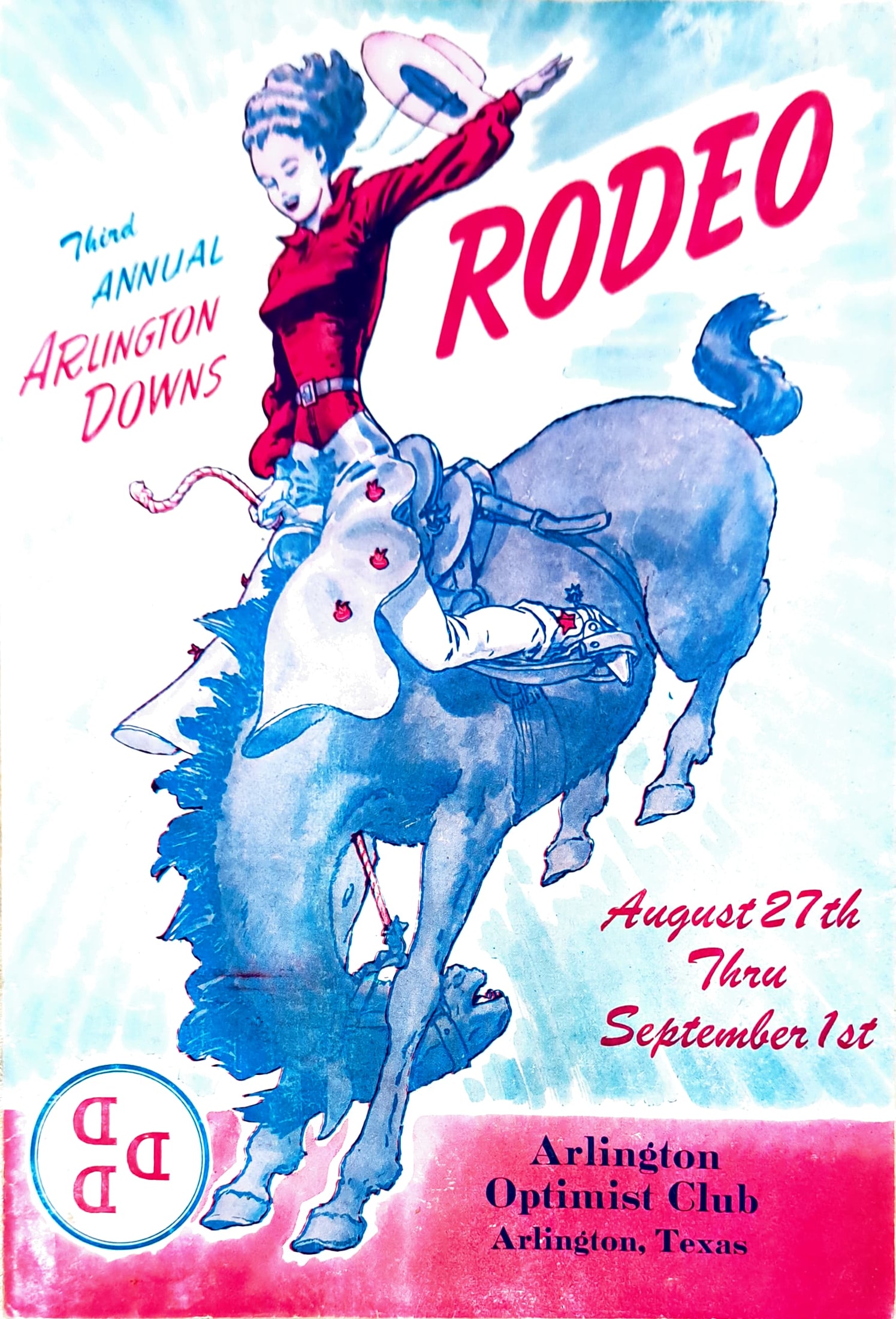
- Racing Program, 1930 || Photo Credit: Tarrant County Archives
- 1934 Fall Meeting at Arlington Downs || Photo Credit: Tarrant County Archives
- Fall 1935 admission ticket to the Texas Jockey Club, Inc. || Photo Credit: Tarrant County Archives
- Third Annual Arlington Downs Rodeo || Photo Credit: Tarrant County Archives
- Movie poster for “To Please a Lady” || Photo Credit: Wikipedia
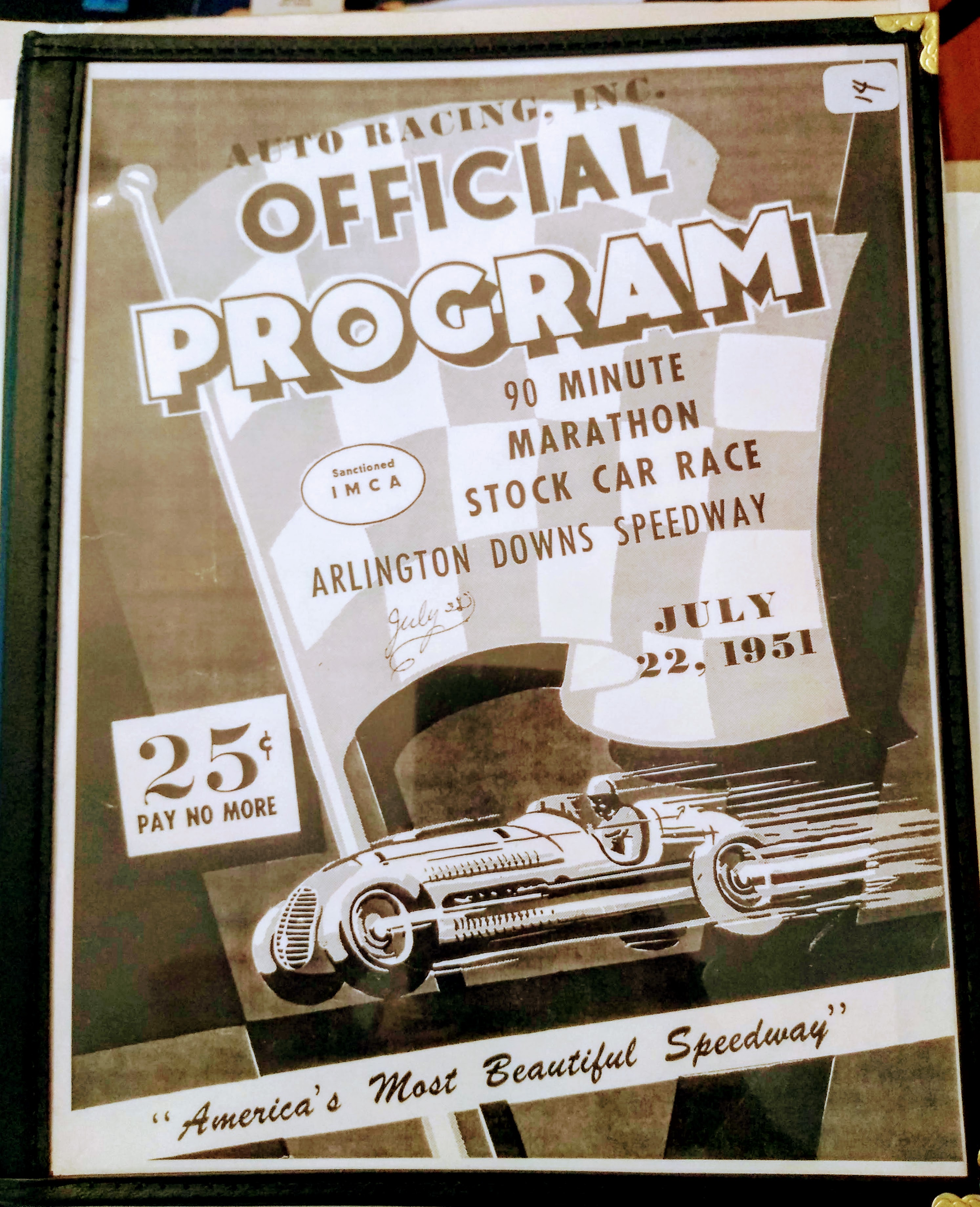
- Official program for a stock car race at Arlington Downs Speedway || Photo Credit: Fielder Museum


Photos of Arlington Downs — believed to be from the 1940s
Photo Credit: UTA Libraries (left), Tarrant County Archives (right)
Today, a small water trough is the only remnant at the site of the original facilities. It’s now used as part of industrial landscaping in a parking lot, and most people who see it likely don’t know what it is. However, the Arlington Downs name lives on with a nearby street name, office building, townhome community, and a Texas Historical Marker, awarded in 1978. The site was also recognized as a City of Arlington Local Landmark in 2016. There is also a mural in Downtown Arlington. Fielder Museum, home of the Arlington Historical Society, has a small exhibit in its collection with artifacts, memorabilia, and photos. UTA Special Collections and the Tarrant County Archives also have items in their collection.
Arlington Downs is a fascinating part of Arlington’s history that drew thousands to our small town and helped put us on the map for tourism. It’s part of a larger tourism arc, one that involved the Bankhead Highway and Top O’ Hill Terrace casino. (Many would legally gamble on the horses and then take the Bankhead Highway across town to the underground casino for illegal gambling and spicy nightlife. But that’s another blog post.)
Arlington Downs is one of my favorite local history topics, as it combines the grit, glamour, and grandeur of horse racing, along with small-town Americana of Arlington into the 1930s, mixed with an entrepreneurial spirit, and a zest for being the best.
There’s always a longshot in horse racing, that one horse who doesn’t stand much of a chance of winning. But sometimes, that horse comes from behind and emerges as a contender. Maybe they don’t win, yet they surprise everyone. They make a mark. That’s Arlington—the American Dream City—and the spirit of Arlington Downs still pumps through our veins, even 95 years since that first race.
And some say, if you listen closely on a quiet night along Division Street, you can still hear the thundering hooves of our past.

Arlington Downs Mural by Lee and Sheri Hay — Downtown Arlington


Portion of the Arlington Downs exhibit at Fielder Museum

Texas Historical Marker – Site of Arlington Downs Racetrack

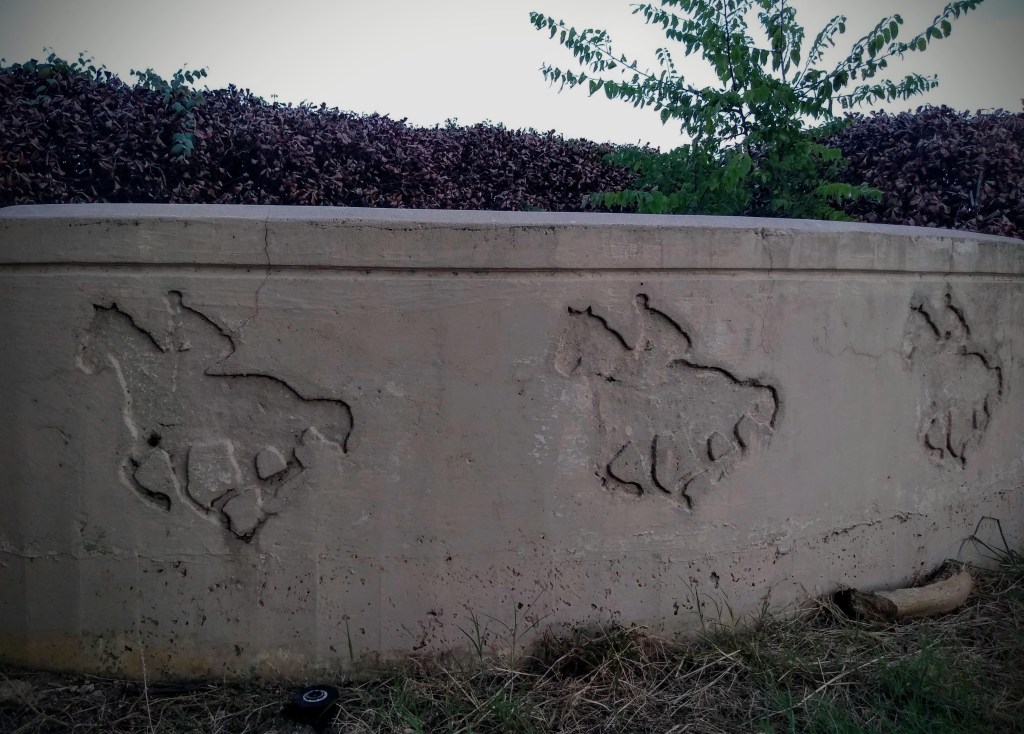
Arlington Downs Tower || Water trough from original facilities

Dedication Announcement for Local Landmark plaque – April 2016
Photo Credit: Fielder Museum Facebook page
Blog post and uncredited photos by Jason S. Sullivan, 11-30-24
 Jason S. Sullivan