July 17, 2024—Today marks the 80th anniversary of the Port Chicago military disaster in which a munitions explosion killed 320 people and injured nearly 400 more. Seaman 2nd Class Ross Dee Hunt (1918-1944) was a young Black man from Arlington who died in the tragedy.
Ross Dee Hunt
Ross Dee Hunt was born in Arlington on February 25, 1918, to parents Arthur and Alice Williams Hunt. He had two older brothers named Horace and Morris. The family attended Mount Olive Baptist Church and strove to be involved in the community. Arthur, Morris, and Ross were also members of Mason Lodge #103, located in Mosier Valley. Ross married Curley Bee Hudson, and the two had a daughter named Dixie Faye, born in 1941.
Military Service
Many young Black men joined the military to serve their country. Yet, they also joined because of economic necessity and its educational opportunities. (Most school districts at this time, including Arlington, didn’t provide education to Black students after the 8th grade. Jobs were also limited.) Similar to civilian life, the military was segregated during this time. Most Blacks served as cooks or stevedores—crew members who loaded or unloaded ships. Discrimination was also common.
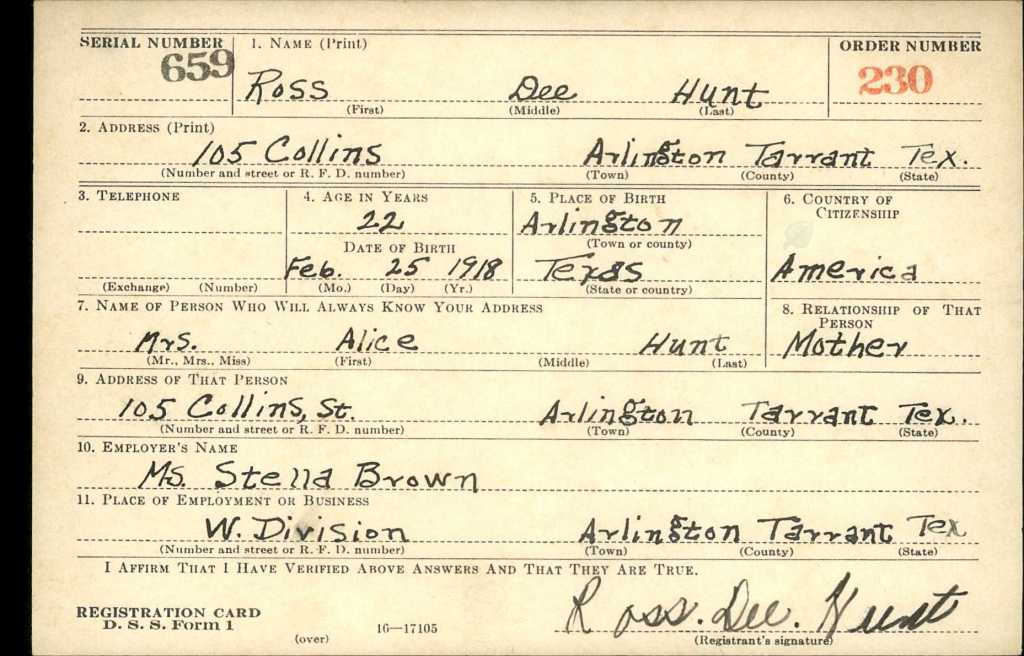
Ross Dee Hunt’s Draft Card
Photo Credit: UTA Memorial to the Fallen
Hunt enlisted in the U.S. Navy as a Seaman Apprentice (E-2) in 1942. During his service, he loaded munitions at the Port Chicago Naval base near San Francisco, California. Loading munitions was hazardous and physical, often performed by young men with little experience. Trains arrived daily with munitions. Port Chicago was in continuous operation to keep up with the demand in the Pacific Theater. It was a transport site, not a storage site. This meant they needed to quickly unload munitions from railroad cars and load them onto ships. The fast-paced nature of the site, mixed with lax safety measures, inadequate training, racial inequality, and stressful work, made it a volatile environment.
Port Chicago disaster
Disaster struck in the late hours of July 17, 1944, at the Port Chicago Naval Munitions base. Two explosions, six seconds apart, resulted in 320 deaths, of which 202 were Black men. Most died instantly from the impact, with nearly another 400 injured. Two transport ships, the SS Quinault Victory and the SS E.A. Bryan, were destroyed, as were the pier and many railroad cars. The small town of Port Chicago also suffered extensive damage. It was the nation’s largest homeland disaster in World War II. The tragedy would also help highlight racial inequalities in the Navy, as a disproportionate number of Blacks were often assigned to labor-intensive tasks rather than fighting in combat.
Port Chicago Alliance | 1944 Newsreel – The Port Chicago Disaster
A few days later, a newspaper reported that Hunt, age 26, was one of the casualties. He was one of only 48 individuals whose remains could be identified. Officials returned his body to Texas for burial at Mosier Valley Cemetery in Euless. His epitaph reads, “His life an ideal, his memory an inspiration.”

Undated newspaper clipping, believed to be from the Fort Worth Star-Telegram in July 1944.
Photo Credit: UTA Memorial to the Fallen
In Memoriam
Ross Dee Hunt received the World War II Victory Medal and the American Campaign Medal for his sacrifice and service. Arlington honors him at the World War II Memorial near City Hall. His name and rank are listed on the plaque “In Memoriam | The World War II Casualties of Arlington, Texas.”
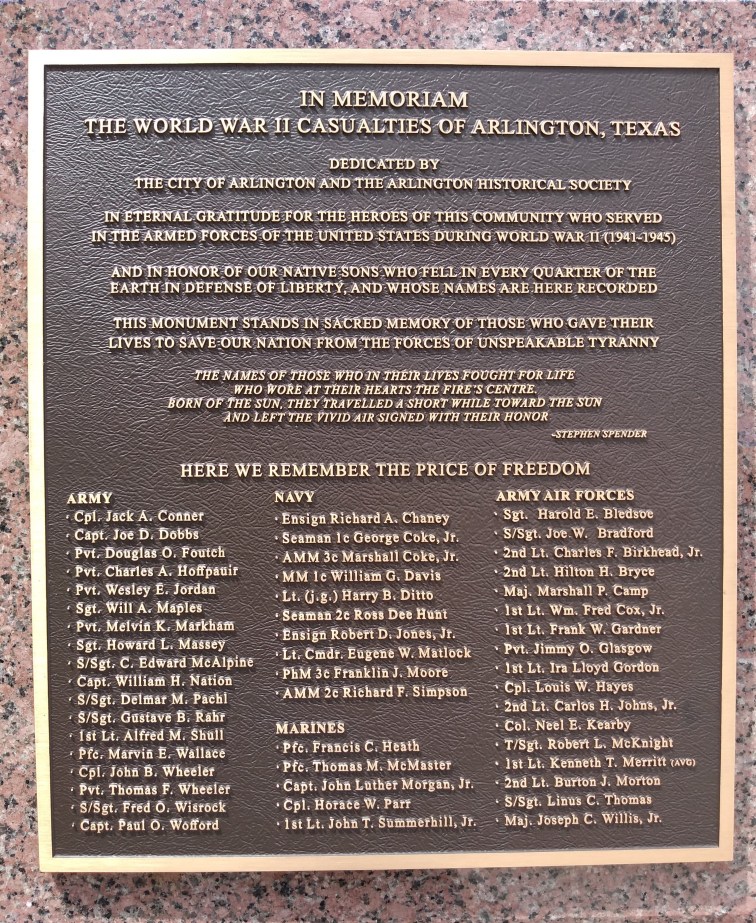
In Memoriam | The World War II Casualties of Arlington, Texas
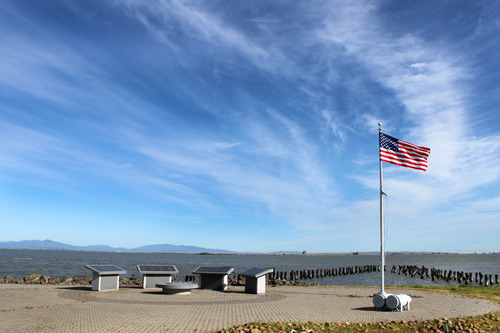
The blast site is now known as The Port Chicago Naval Magazine National Memorial. Dedicated in 1994 for the 50th anniversary, it became part of the National Park System in 2009.
The Port Chicago Naval Magazine National Memorial (Photo Credit: NPS/Luther Bailey)
Port Chicago Alliance | Into Forgetfulness: The Port Chicago Disaster (short documentary)
Regrettably, we know little about Hunt and many of the other casualties. Only Hunt’s draft card, a small newspaper clipping, and a headstone photo were readily available. It’s essential to keep his memory alive in whatever ways we can.
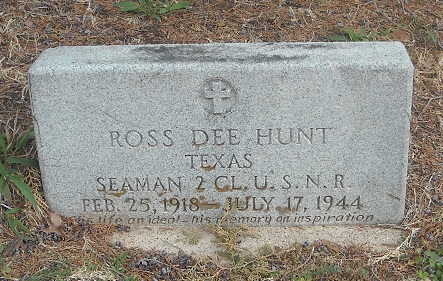
Ross Dee Hunt headstone at Mosier Valley Cemetery
Photo Credit: Cissy Currie / Find-A-Grave
Arlington is deeply grateful for the service of Ross Dee Hunt and the other World War II service members.
Thank you to Sabra Johnson of the Arlington Historical Society for her invaluable research!
For more info about the Port Chicago disaster, visit:
www.nps.gov/poch/index.htm
Blog post by Jason S. Sullivan, 07-17-24
 Jason S. Sullivan