Local historians consider July 19, 1876, to be the date that Arlington, Texas, was founded. It was on that date that the railroad came through our area for the first time, and the tiny settlement that formed around the tracks would become known as Arlington. Events certainly happened here before that date—and many of them were quite significant—but the arrival of the railroad began a new era. While the date typically isn’t celebrated in Arlington, it’s a day that changed our history forever.
Plans for a transcontinental railroad
In 1871, Congress granted a charter for a railroad across the southern United States, including a route through Texas. The Texas and Pacific Railway Company, often referred to as T & P Railroad, was given the charter. The east-west route in Texas would connect Marshall (near Louisiana and Arkansas) with El Paso to the west. The railroad was expected to connect the North Texas cities of Dallas and Fort Worth by January 1874.
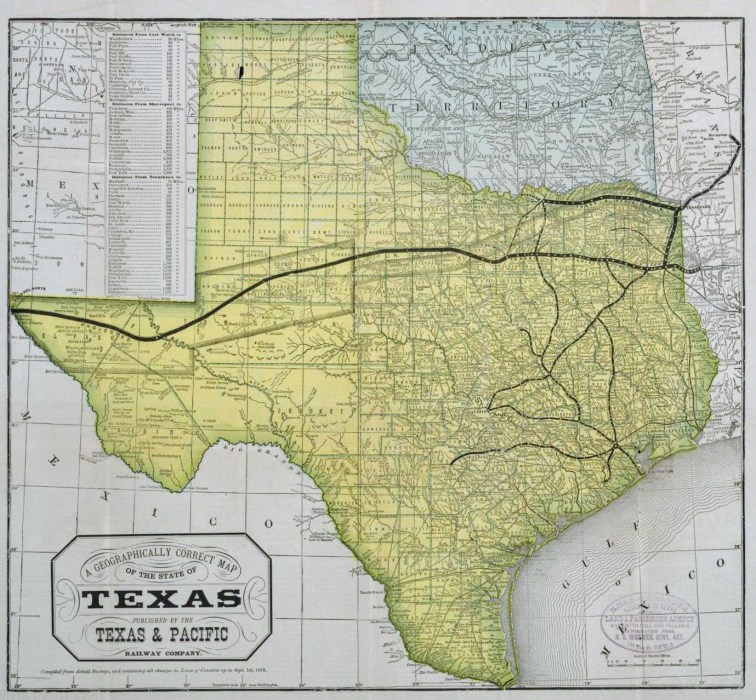
Texas & Pacific Railroad Map
Railroad construction began in 1872, with the line from Longview to Dallas in service by July 1873. Construction would soon come to a halt, though. The Panic of 1873, a financial crisis that led to a depression, affected the economy. Progress slowly continued, but the railroad eventually stopped at Eagle Ford, a settlement past Dallas and near present-day Grand Prairie. It was less than 30 miles short of connecting to Fort Worth, yet it would take another three years to complete. (This also may be partly why Dallas ultimately grew faster and larger than Fort Worth.)
Arlington gets its start
According to local journalist O.K. Carter, Arlington started like many small settlements as “empty acreage on a railroad route.” [Carter, page 46] Railroads often sold land to make new communities. Those communities, in turn, would rely on the railroad for shipping and transportation, which created both a supply and demand.
The railroad was initially expected to pass near or through Johnson Station, an early settlement now part of present-day Arlington. It seemed a logical choice because the site was already established, having a general store and post office. However, a landowner in the area supposedly refused to sell their land, forcing surveyors to determine another suitable route to continue westward. The site chosen would be three miles north of Johnson Station, in its present-day location. Smaller settlements, including Johnson Station and many others, would become obsolete as folks moved closer to the railroad tracks.
Railroad construction resumed by January 1876, but time was of the essence. Officials would revoke funding if the railroad didn’t arrive in Fort Worth by the deadline of June 30. Heavy rains in early spring caused delays. Conditions improved, but the deadline loomed ahead. The community came together and even helped the railroad workers, sometimes working into the night with lanterns.
Tarrant County was able to get a two-week extension, but it still wasn’t quite enough. Yet, since only a few miles remained, officials granted one last extension of 72 hours. In a final effort, Fort Worth moved its train depot to meet the track. The railroad was finally ready to connect Dallas and Fort Worth.
The train arrives – July 19, 1876
People traveled for miles to witness the train’s arrival. It was an event that some thought would never happen, and for many, it was their first time to see a train. There was a great feeling of anticipation and even a celebratory feel—folks dressed in their finest and enjoyed picnics while clustering near the track. It was a special occasion, indeed.
Onlookers first heard the whistle and saw the smoke, with the train finally coming into view. As the train approached, accounts say that some parents had to hold their children back from running towards it in excitement—while others in the crowd were frightened as it rumbled to a stop. The crowd collectively held their breath for a few tense moments while the dust settled. But, there was soon a sense of relief when the train conductor waved to the crowd. People cheered, and a celebration ensued.
Engine #20 of the Texas & Pacific Railroad arrived in Arlington around 9:00 AM. It was painted black with gold striping; it had polished brass and a red cattle guard—also known as a cow clearer. It is believed that the locomotive pulled four cars and had a crew of three men.
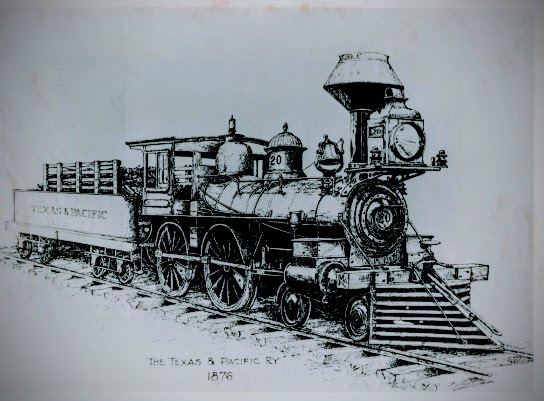
Engine #20 of the Texas & Pacific Railroad, 1876
Arlington wasn’t the end of the line, though. The train soon left the station and continued west to Fort Worth. Accounts say it took around two hours to get there. It arrived at the Fort Worth station at 11:23 AM and was met with a similar welcome.
Local historians generally consider July 19, 1876, to be the date that Arlington was founded. Events certainly happened here before that date—and some of them were quite significant—but the arrival of the railroad began a new era.
Reverend Andrew S. Hayter: The Father of Arlington
When discussing the railroad’s arrival in present-day Arlington, one must mention Reverend Andrew S. Hayter and his role.
Reverend Andrew S. Hayter (1818-1900) had arrived in the area with his family by 1869 and purchased land. Hayter, pronounced “High-ter,” was a Presbyterian preacher and land surveyor originally from Tennessee by way of Alabama. When railroad construction resumed early in 1876, Hayter was working with the railroad as a consultant for surveying the land. He supplied trees from his land for construction materials and even provided a place for railroad workers to camp. The railroad sought his help in plotting a new half-mile-square settlement between Dallas and Fort Worth. Yet, the new settlement, which would be located along the railroad, still needed a name.
It’s believed that the railroad offered to name the new settlement after Hayter for his services, either as Hayter or Hayterville—or at least give him naming privileges. Yet, it’s said that Hayter—and possibly Postmaster James Ditto, Sr.—suggested the name “Arlington” instead. The name was in honor of Robert E. Lee’s hometown in Virginia; Lee had served in North Texas at one point and met both Hayter and Ditto. The settlement would be known as Arlington sometime during 1876-1877, although it took time for the name to become widely accepted, used, and printed on maps. Even though the town was founded in 1876, for reasons unknown, it wouldn’t officially incorporate as a town until April 21, 1884.
While some details of the town’s naming are unclear, Hayter’s impact on the railroad and how it affected Arlington’s future is not. His efforts surely helped lay the foundation for Arlington and its growth. As such, he would later become known as the “Father of Arlington.” Today, there is a Texas Historical Marker and a bronze bust of Reverend Andrew S. Hayter in Downtown Arlington, not far from the railroad tracks.

The Railroad’s Impact on Arlington
Railroads were vital to western expansion in America. They’re still used today, of course, but their popularity and the nation’s reliance on their services began to diminish around the 1950s as the aviation and automotive industries became more prominent. The early days of the railroad, though, transformed more than America’s landscape. People, information, supplies, and goods could now be sent much faster by rail instead of the stagecoach. Commerce experienced a boom, while small towns often sprung up along the railroad tracks—including Arlington.
Arlington likely owes its existence to the railroad, as do many towns in America. Arlington would be known as a stop between Dallas and Fort Worth well into its 20th-century history—although it has carved its own identity over the years, both by design and determination. Transportation would be a recurring element in Arlington’s history, with each advance having more of an impact. Despite the advances, the train still passes through Arlington today.
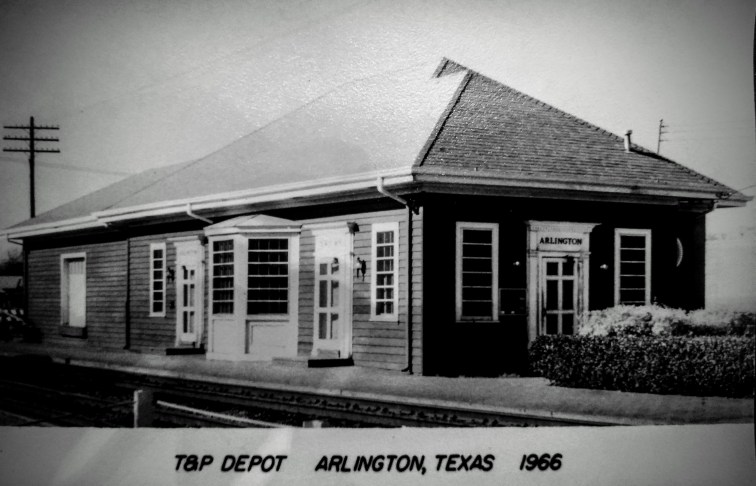
Arlington had three train stations over the years. The first, built in 1876, literally put Arlington on the map. The station burned down in 1901. It was rebuilt and served Arlington from 1904 through 1956; it’s an iconic building that had a prominent tower. Around 1917, the train station was remodeled to include a lobby, waiting rooms, indoor restrooms, and separate rooms for bag storage, records, and freight. The third and final station served Arlington from 1956 to 1969; it included both freight and passenger trains until passenger service was discontinued in 1969. With no further need for the building, it was demolished. Yet, there is a section of the wooden platform that still remains. For over 90 years, the site served as part of our history, and there’s an application submitted (and approved, I believe) to have it recognized with a Texas Historical Marker.
Over the years, the train station served as a social and commerce hub for Arlington, with people wanting to see who or what came into town. By the early 1900s, six trains stopped in Arlington daily—the town was bustling with a population of over 1,000 people and had five cotton gins. Many young men left Arlington via the railroad and headed off to World War II—some returned the same way, while for others, it was their last memory of Arlington. In the early 1950s, the train station served as a community rallying point, where shipments of supplies, aid, and care packages were sent to Bad Königshofen—a small town in West Germany that would become Arlington’s Sister City, and still is, even after 70 years.
Without the railroad, Arlington may not have grown to a city of 400,000 people and a size of nearly 100 square miles. Towns were not only created by the railroads—they also lived and died by them as well. While July 19 isn’t typically celebrated in Arlington, the arrival of the railroad 147 years ago changed the course of Arlington’s history forever. Notably, the “City of Arlington” Texas Historical Marker was dedicated on July 19, 2006, to help celebrate the city’s 130th anniversary.
Photos
Photos, postcards, and a model of the train depot – courtesy of the Fielder Museum and Arlington Historical Society.



Resources
- Arlington High School – Texas History Class of 1958 (compiled by). The History of Arlington. 1958.
- Carter, O. K. Caddos, Cotton and Cowboys. 2012.
- Henning, Carol Werdman. Wild West Days of Arlington, Texas. 1972.
- Joyner, Arista. Arlington, Texas: Birthplace of the Metroplex. 1976.
- Nichols, Mike. Lost Fort Worth. 2014.
- Werner, George C. “TSHA | Texas and Pacific Railway.” TSHA, https://www.tshaonline.org/handbook/entries/texas-and-pacific-railway. Accessed 19 July 2023.
Photo Credits
Texas & Pacific Railway. A geographically correct map of the State of Texas: Compiled from actual surveys, and containing all changes in lines of counties up to Sept. 1st, 1876., map, 1878; St. Louis. (https://texashistory.unt.edu/ark:/67531/metapth193691/m1/1/?q=Texas: accessed July 22, 2023), University of North Texas Libraries, The Portal to Texas History, https://texashistory.unt.edu; crediting University of Texas at Arlington Library.
T&P Train #20, photograph, 1876; (https://texashistory.unt.edu/ark:/67531/metapth853367/m1/1/?q=T%26%20P%201876: accessed July 22, 2023), University of North Texas Libraries, The Portal to Texas History, https://texashistory.unt.edu; crediting The Grace Museum.
Photos, postcards, and model of the train depot – courtesy of the Fielder Museum and Arlington Historical Society.
Blog post by Jason S. Sullivan, 07-20-23 (original July 2021; revised July 2023)
 Jason S. Sullivan
Jason – another great story and detail! But where is this? “ With no further need for the building, it was demolished. Yet, there is a section of the wooden platform that still remains”
LikeLiked by 1 person
Thanks, Brian! Good question! The wooden platform is in Downtown Arlington, near Center and Front Streets. It’s in between the Downtown Library and Mellow Mushroom, in the grassy area near the railroad tracks. There’s not much left of it, and you probably wouldn’t know what it was if you even saw it. I’ll take a photo of it next time I’m over there.
LikeLike