I wrote this walking tour for the Arlington Historical Society newsletter. It was divided into two parts, with Part 1 appearing in the February/March 2021 edition and Part 2 in the April/May 2021 edition. It was my first time being published in the newsletter!
I plan to update this tour and include an interactive map.
From Hayter to The Hill: Tour Historic Downtown Arlington
History comes alive in Downtown Arlington! A short trek up Center Street offers a unique look at the city’s past. Much of Downtown Arlington is pedestrian-friendly, and this tour would be a great way to explore the area on foot.
Part 1 explores some of the city’s founders and early history. Part 2 takes us through historic neighborhoods that are still thriving today. Along the way, there are historical markers, local landmarks, people, places, and events.
From Hayter to The Hill, let’s begin the Historic Tour of Downtown Arlington!
Part 1
Part 1 highlights –
- Founders Plaza
- City of Arlington historical marker
- George W. Hawkes downtown library branch
- Knapp Heritage Park
- Bankhead Highway through Arlington historical marker
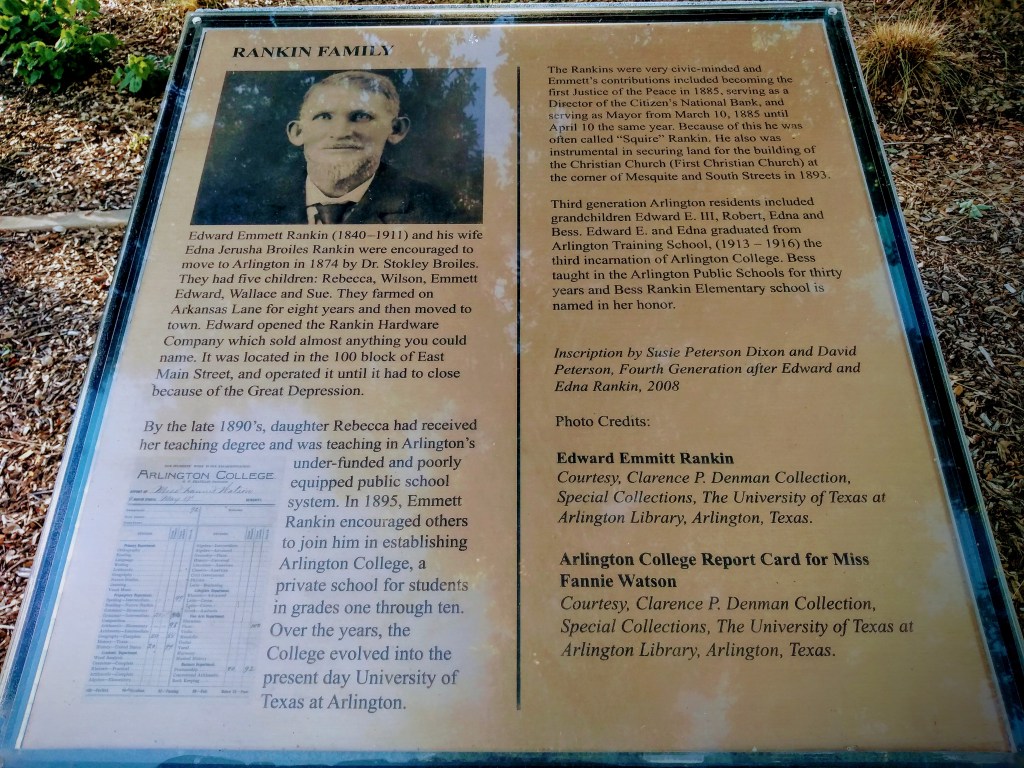
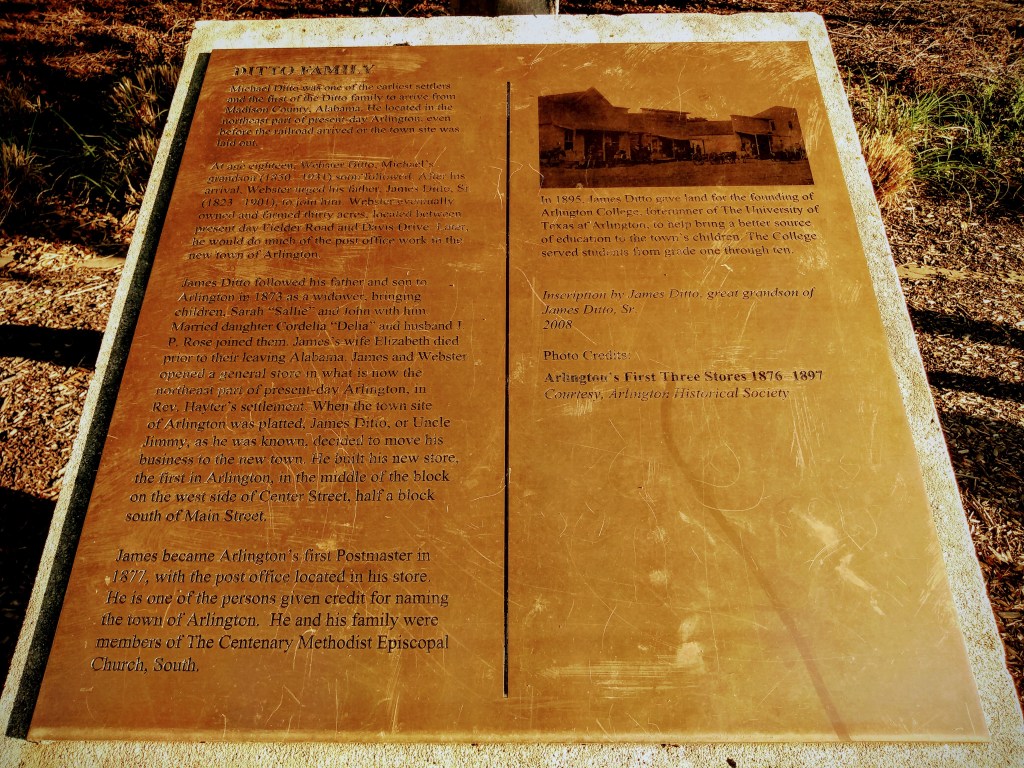
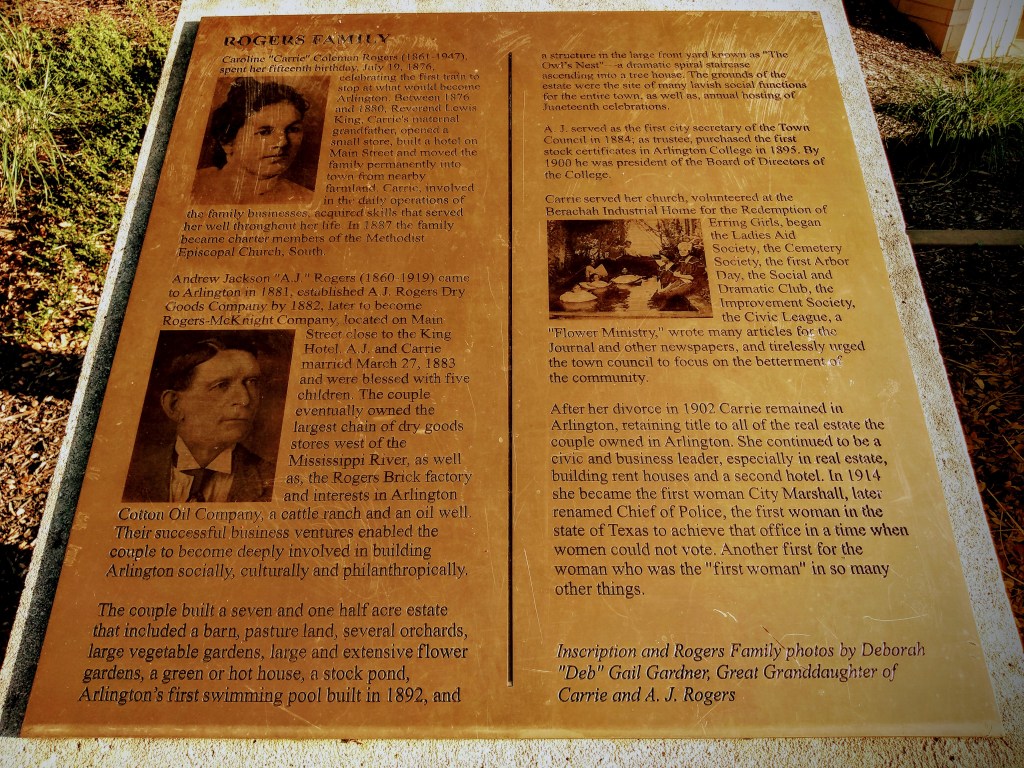
To start the tour, head to Founders Plaza. It’s located at the Levitt Pavilion near Center and Abram Streets. The first stop is the Andrew Hayter bronze bust and historical marker. Originally from Tennessee, Reverend Hayter (1818-1900) was one of the early settlers in the area. He is known to many as the “Father of Arlington.” A pioneer preacher, as well as a surveyor, his skills proved helpful to railroad developers. His half-mile-square settlement, known as “Hayter” or “Hayterville,” would eventually become Arlington.

Founders Plaza also has plaques for six of the founding families of Arlington. These plaques provide information, stories, and photographs of the families and the town’s early days. Take a few minutes to read about the Rose, Rankin, Cooper, Collins, Ditto, and Rogers families. These families helped lay the foundation of modern-day Arlington.



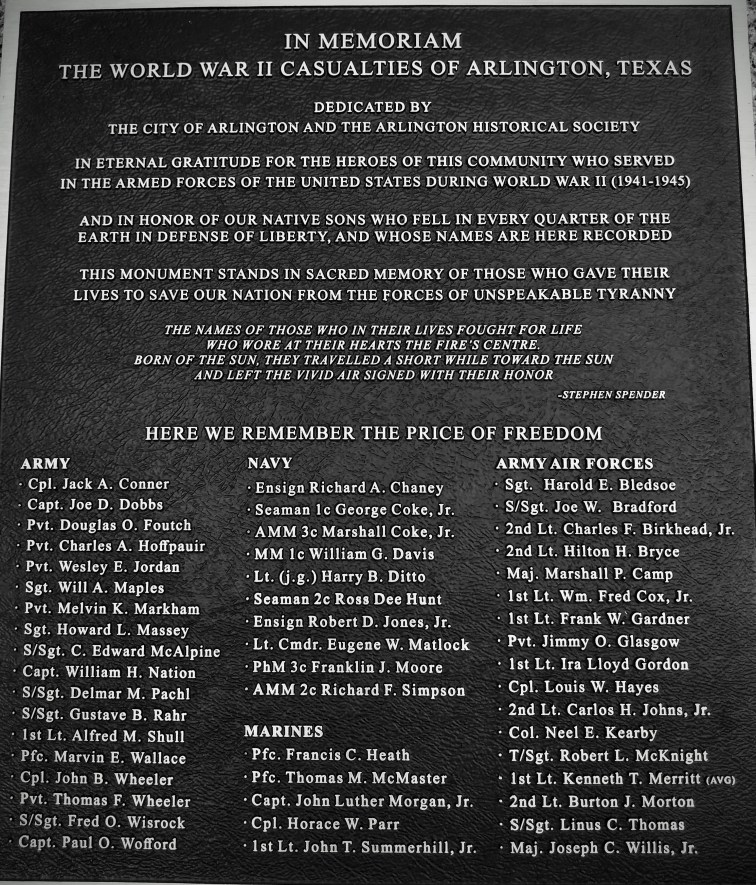
Next, head north on Center Street to the City Center Plaza and visit the World War II Memorial. There’s a historical marker and a life-sized bronze statue of Colonel Neel E. Kearby. Colonel Kearby (1911-1944) graduated from Arlington High School in 1928 and studied at what is now UTA. He joined the U.S. Army Air Corps and was a highly decorated fighter pilot in World War II. His awards include two Silver Stars, four Distinguished Flying Crosses, five Air Medals, and a Purple Heart. Notably, he was awarded the Medal of Honor in 1944, a few months before being killed in action.
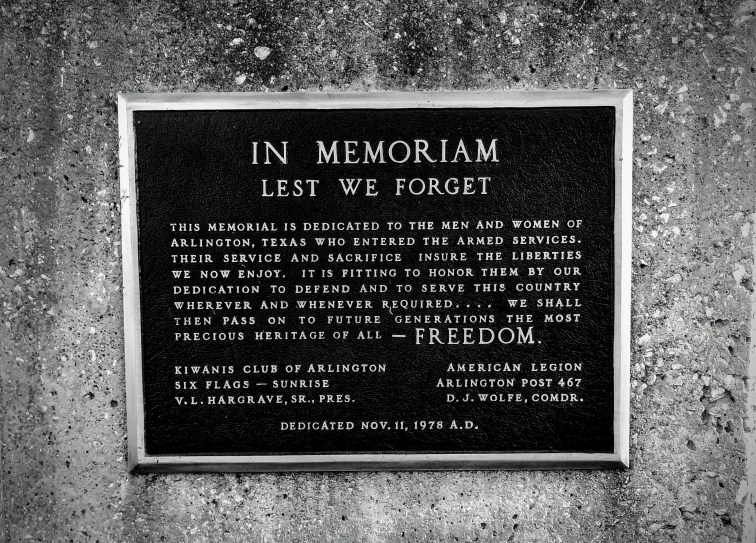
Also in the area are three other historical plaques. The first plaque pays tribute to heroes from Arlington who gave the ultimate sacrifice in World War II. The second plaque explains how the North Texas Agricultural College (1923-1949), now UTA, got involved with the wartime efforts and their impact. The third plaque, “In Memoriam – Lest We Forget,” pays tribute to the service and sacrifice of the men and women of Arlington who entered the Armed Forces.



Near City Hall is the City of Arlington historical marker, which gives a brief overview of our city. Slightly to the west — across from the Arlington Museum of Art — is Worthington National Bank. It’s a City of Arlington Local Landmark, built in 1939. Serving as the City of Arlington Post Office until 1964, the building was restored in 2001 and became a bank.


Before leaving City Center Plaza, a worthy detour is the Arlington Public Library’s downtown branch. They have an entire room dedicated to Genealogy and Local History, with books, special collections, maps, newspapers, databases, and many more resources.
Wow! All of that, and we’ve barely started the tour. Let’s keep going. The next stop is one of the Arlington Historical Society’s venues: Knapp Heritage Park.
Knapp Heritage Park contains three of the oldest structures in Arlington. You can tour cabins from the mid-1800s and a 1910 schoolhouse. Also on display are a blacksmith shop, a general store, a water storage tank, a windmill, and even James Knapp’s former law office.

Part 1 of the tour is not over yet. Let’s head back to Center Street and stop by Arlington Music Hall.
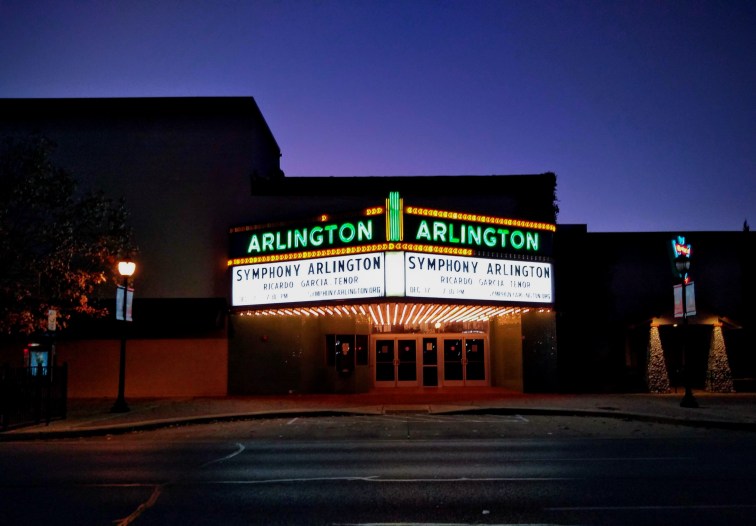
Arlington Music Hall opened in 1950 as a movie theatre. The marque sign outside still looks as it did back then. Today, this City of Arlington Local Landmark is a performance venue. This intimate theater is a great place to see concerts, especially Symphony Arlington.
The last stop on Part 1 of the tour is nearby at Division Street. Check out the “Bankhead Highway through Arlington” historical marker. The name of this east-west route has changed over the years, but it helped make Arlington what it is today. Known today as Division Street, this route helped transform Arlington from a small town to a thriving community. Tourism, commerce, and travel all benefited, and so did the city.

Across the street from the marker is the historic Vandergriff Building. The Vandergriffs were an influential family in Arlington’s history. The building starts Part 2 of the tour. We’ll also visit the residential areas of the Old Town Historic District and The Hill.
Part 2
Part 1 started in Founders Plaza. We visited Andrew Hayter and learned about some of the founding families. City Center Plaza had Arlington’s World War II Memorial, the City of Arlington historical marker at City Hall, and the downtown library to explore local history and genealogy. Knapp Heritage Park and Arlington Music Hall were towards the end, with the Bankhead Highway through Arlington historical marker as the finale.
Part 2 highlights –
- Historic Vandergriff Building
- First United Methodist Church of Arlington
- Old Town Historic District
- The Hill neighborhood
Part 2 starts at Center and Division Streets with the Historic Vandergriff Building. With construction completed in 1928, it’s the oldest commercial structure remaining in Arlington. Vandergriff Chevrolet occupied the building from 1937-1966.

In 1937, the Vandergriffs arrived in Arlington. While not one of the founding families, their influence is no less important. Tommy Joe Vandergriff (1926-2010), also known as Tom J., was mayor of Arlington from 1951-1977. His leadership helped bring General Motors Assembly Plant, Lake Arlington, Six Flags Over Texas, and the Texas Rangers to Arlington. From jobs to entertainment and prosperity to growth, Arlington still feels Mayor Vandergriff’s impact.
Today, the Historic Vandergriff Building is a City of Arlington Local Landmark and on the National Register of Historic Places. There are four historical plaques on or near the building, two Vandergriff Chevrolet signs, and a large mural on its south wall. The neon signs, while a fun addition, aren’t original — they were added during renovations. The building’s location near the center of the city’s original boundaries further cements its place as a significant structure in Arlington.
Let’s cross Division Street and continue with the tour. Next up is the First United Methodist Church of Arlington. In 1885, a wooden church was located at this site. Fast forward over 130 years later — at the same site with continuous service — and the church is thriving with over 5,000 members. The church, with its Gothic Revival architecture, is a City of Arlington Local Landmark. It’s also a United Methodist Historic Site, and it has a Texas Historical Marker.

Further north on Center Street is the Old Town Historic District. Inside the district is the Old Town Neighborhood which is listed in the National Register of Historic Places. (Note: Arlington has two historic districts. While not part of this tour, we also have the South Center Street Historic District, located further south than where part 1 of the tour started.)

According to the district’s marker – “Old Town Historic District encompasses approximately seven blocks of late 19th century and early 20th-century residential properties. Located at the northern edge of Arlington’s original town plat, the district’s boundaries include Sanford, North, Elm, and Oak Streets. Architectural styles in the neighborhood include Pre-WWII housing, Queen Anne, Colonial Revival, Bungalow, and Art Moderne. Early residents include city pioneers, community leaders, and merchants.”
Located across from the marker is the boundary for the North Edge of the Original Town. (The marker for the southern boundary is also on Center near South Street.)

After exploring the Old Town Historic District, make your way back to Division Street and head west. Turn right onto N.L. Robinson Drive. Part of West Street, the city renamed a portion of this street after Pastor Dr. Norman Lee Robinson of nearby Mount Olive Baptist Church.
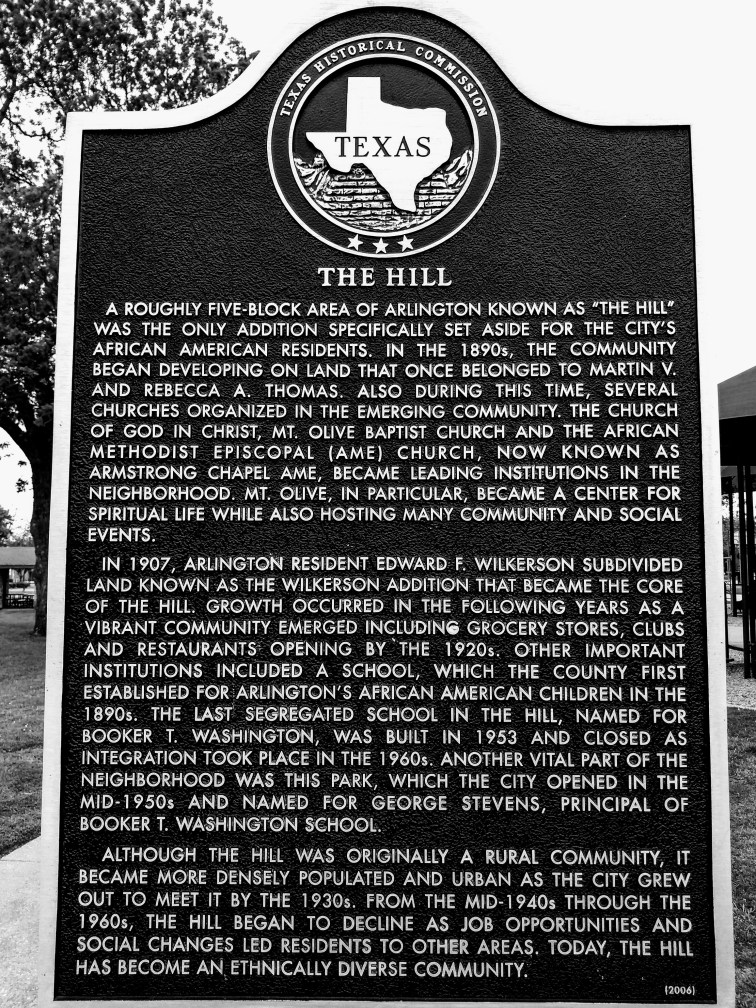
Northwest of the original city boundaries was a five-block area known as “The Hill.” Its area includes Sanford, West (N.L. Robinson Drive,) Prairie, and Taylor Streets. At one time, it was the only area designated for the city’s Black residents when racially segregated neighborhoods were the norm. Although The Hill’s most significant impact was before desegregation during 1890-1950, it remains a vital part of Arlington’s history. Churches and schools were fixtures of The Hill neighborhood, along with homes, stores, and a park.
In addition to Mount Olive Baptist Church, there is what’s now known as the Armstrong AME Church and the Arlington Church of God in Christ. All three churches were founded in the 1890s and are still active today. They each have historical markers on site.

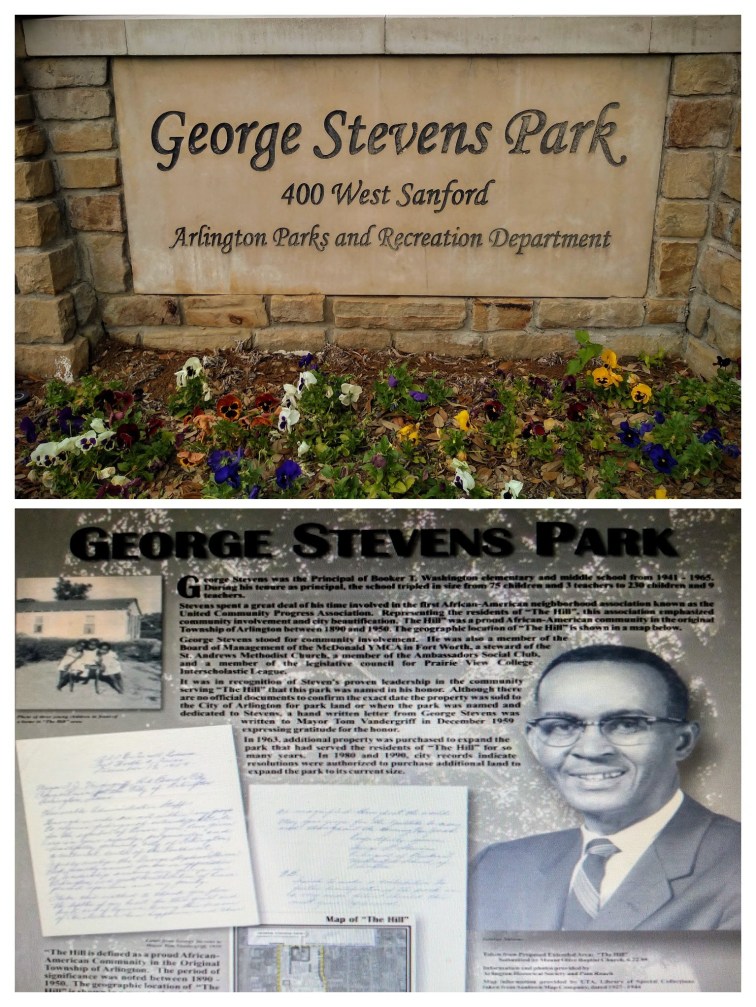
The final stop on the tour is 400 W. Sanford Street. It’s the address for George Stevens Park. Mr. Stevens served as a Principal of Booker T. Washington School (and its precursors) from 1941-1965. It evolved from one of Arlington’s first Black schools and later became part of AISD. The school tripled in size during his tenure. As a tribute to his impact, George Stevens Park is located near the school. Located in the park is a sign with information about George Stevens and a Texas Historical Marker for “The Hill.”
With that, our tour of Historic Downtown Arlington comes to an end. From Hayter to The Hill, we’ve seen significant pieces of Arlington’s history. The distance on a map is less than a few miles, but we’ve traveled back in time to some of Arlington’s earliest and most prominent people and events.
The next time you’re on Center Street, take a trip through the past and tour Historic Downtown Arlington.
Note: This article first appeared in the February/March 2021 edition and April/May 2021 edition of the Arlington Historical Society’s newsletter.
For more about Arlington’s history, be sure to visit the Arlington Historical Society’s website and Facebook page. If you’re in the area, visit the Fielder Museum (home of the Arlington Historical Society) at 1616 W. Abram Street in Arlington.
Blog and photos by Jason S. Sullivan, 05-25-21; updated 07-10-23
 Jason S. Sullivan
Good job!
LikeLiked by 1 person
Thank you!
LikeLike
I have lived near downtown Arlington over 34 years and feel I did not know my city until now. Thank you for the informative, well-written article. You have a new fan!
LikeLike
Thank you for stopping by! Glad you enjoyed it.
LikeLike