March 15, 1885—On this day, Texas and Pacific Engine No. 642 met a dramatic end, plunging into the swollen waters of Village Creek. It’s believed to still be there.
The Wreck of Engine 642 at Village Creek
As the late-great local historian Mike Nichols described it: “The late-winter rains of 1885 had been heavy, and on March 15 rain continued to fall, putting Village Creek between Fort Worth and Arlington in a mood: out of its banks, running high, wide and ruthless.” (Today, this stretch of Village Creek is within Arlington city limits.)
Heavy rain led to flooding, with the 70-foot wooden bridge over Village Creek requiring reinforcements. Although work was previously done to strengthen the bridge, the rains continued and gnawed away at the repairs.
Nonetheless, early on March 15, an eastbound passenger train left Fort Worth en route to Texarkana. Engine 642, an iron behemoth weighing over 70,000 pounds, pulled a handful of cars with it.

One of the few photos of Texas and Pacific Engine No. 642 believed to exist.
Photo Credit: UTA Libraries Digital Gallery and the Jack White Photograph Collection
Shortly into its journey, and after the train descended the infamous “Arlington Hill,” Engineer Lyman Roach prepared to cross the Village Creek bridge. Once he saw the water’s height—only about four feet from the track and over ten feet higher than normal—he desperately tried to stop. It was too late. The weakened bridge buckled under the massive weight. The engine, mail coach, and baggage car, along with most of the bridge, plunged into the rushing water. Another car dangled precariously, with the last one in line derailed.
Several injuries were reported; Engineer Roach was battered but would survive. Tragically, Fireman J. G. Hobeck perished, though remarkably, passengers escaped unscathed. (Note: Some sources have his surname as “Habeck”—unsure which is correct.)
Pulling the wreckage from the creek proved challenging. The creek bank was steep and muddy, with the engine submerged and sinking deeper into the muck. The other two cars were eventually recovered, and within a few weeks, the bridge was back in service. Yet, Engine 642 remained there and was abandoned.
During a 1929 bridge reconstruction, workers reported seeing the engine, yet left it undisturbed. Numerous searches have since failed to locate it. The exact location now is unknown, although it’s widely believed to still be in the creek. Excavating a massive 1800s train engine near a former highway (and now a busy street) would have been a conspicuous and newsworthy affair. Yet, how does a 70,000 pound train engine get lost in a creek? Despite Village Creek being a tributary of the Trinity River and over 20 miles long, the creek is fairly shallow in most places. It’s an enigma.
Today, amid the dense trees and undeveloped land along the creek, it would take a tremendous effort to remove the engine—that is, if you could even find it and if it was feasible to do anything. Locating the engine would require specialized heavy equipment, and the logistics of reaching the creek bank are daunting. Many also think such attempts would weaken the soil and render the bridge unsafe, causing further expenses and roadblocks in an already prickly endeavor. And what would someone even do with the engine if one miraculously could and did remove it? Display it somewhere, perhaps, but transportation and restoration would be needed, adding further expenses and challenges.
Like a shipwreck lost at sea, the whereabouts of Engine 642 in Village Creek may remain a mystery.

The Texas & Pacific railroad bridge over Village Creek, built in 1929 to replace the older bridge,
can still be seen adjacent to West Division Street on the south side of the road.
Photo Credit: Arlington Historical Society
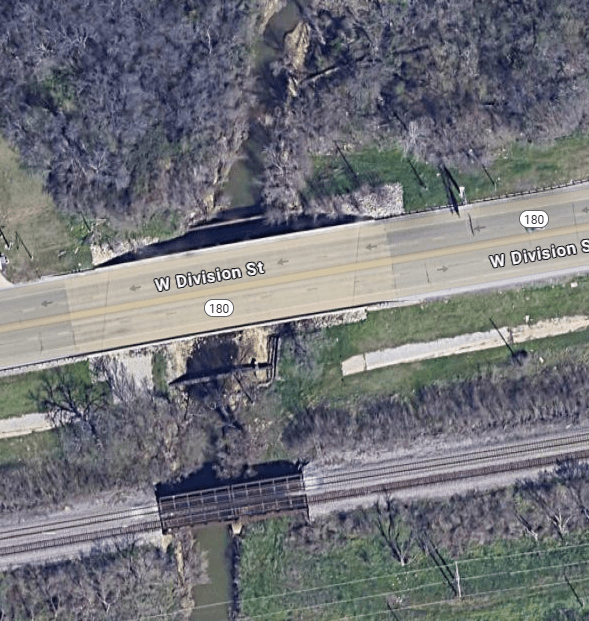
A view of the terrain around Village Creek and Division Street in Arlington.
Near the bottom of the photo is the bridge from the photo above.
Photo Credit: Google (screenshot)
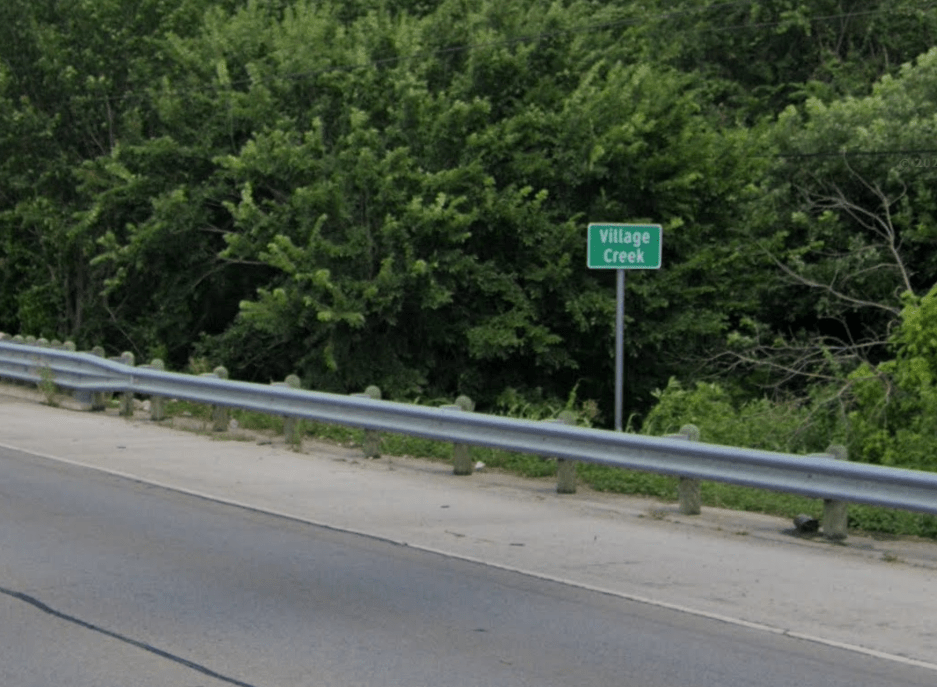
Dense trees around Village Creek help cloak the mystery.
Photo Credit: Google (screenshot)
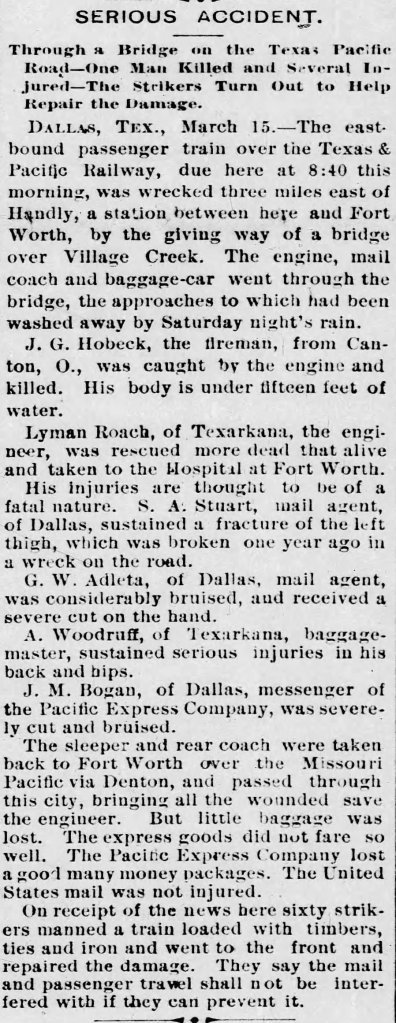
One of the more detailed newspaper clippings about the event.
The Taylor County News (Abilene, Texas) – March 27, 1885
Photo Credit: Newspapers.com
Blog post by Jason S. Sullivan, 03-15-25
 Jason S. Sullivan
Your content is so interesting! I enjoy your articles and look forward to reading them.
LikeLiked by 1 person
Thank you! Glad you enjoy it.
LikeLike